
🔋 The Battery Breakthrough Hiding Inside Your Next EV Fast Charge

Most EV drivers think charging speed is limited by charger power.
It isn’t.
The real bottleneck lives deep inside the battery itself — in a microscopic electrochemical balancing act that can permanently damage a cell if charging happens too aggressively.
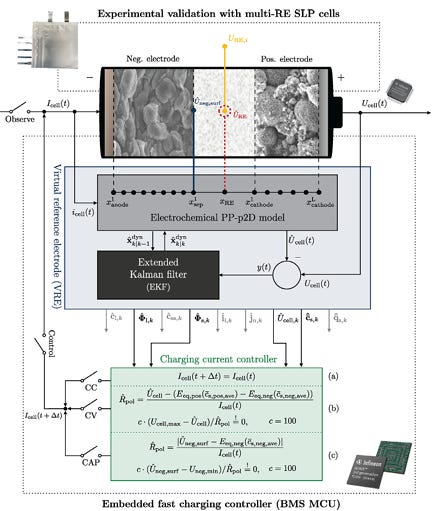
A new paper from researchers at the Technical University of Munich, BMW, Infineon, and Fraunhofer suggests we may finally have a practical way around that limitation. Their approach combines electrochemical modeling, embedded systems engineering, and real-time control to create something remarkable:
A battery that can “feel” when lithium plating is about to happen — and dynamically adjust charging current before damage occurs.
This is not just another incremental battery optimization paper.
It represents a meaningful step toward software-defined fast charging.
And if it scales successfully, it could fundamentally change how EVs charge.
Why Fast Charging Is So Hard
At the center of the problem is a phenomenon called lithium plating.
During charging, lithium ions are supposed to move from the cathode into the graphite anode and intercalate neatly between graphite layers.
But when charging happens too quickly — especially at high states of charge or low temperatures — the graphite can’t absorb lithium fast enough.
Instead, metallic lithium begins depositing on the anode surface.
That’s lithium plating.
The consequences are severe:
permanent capacity loss
accelerated degradation
safety risks
shorter battery lifespan
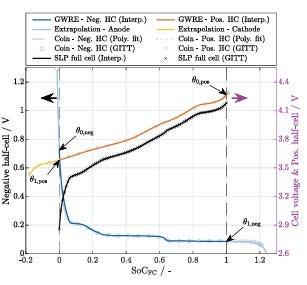
The paper explains that plating becomes thermodynamically favorable when the anode surface potential drops below 0 V vs. Li/Li+.
The challenge is that this critical anode potential is effectively invisible inside a commercial battery.
You can measure overall pack voltage.
You can measure current.
You can estimate temperature.
But you cannot directly measure what’s happening at the anode surface in real time.
That hidden electrochemical state is the true limit on charging speed.
The Core Idea: A “Virtual Reference Electrode”
The authors solve this problem using what they call a virtual reference electrode (VRE).
Instead of physically measuring the anode potential, they build a high-fidelity electrochemical model that estimates it in real time.
